
Finer means more surface area
Smaller particles give water more surface to work on. They usually slow the brew and increase extraction, which is how much flavour the water pulls from the grounds. Coarser particles drain faster and extract less.
That makes grind the main lever for changing extraction without changing the recipe. Keep dose and water fixed, and move the grind first.
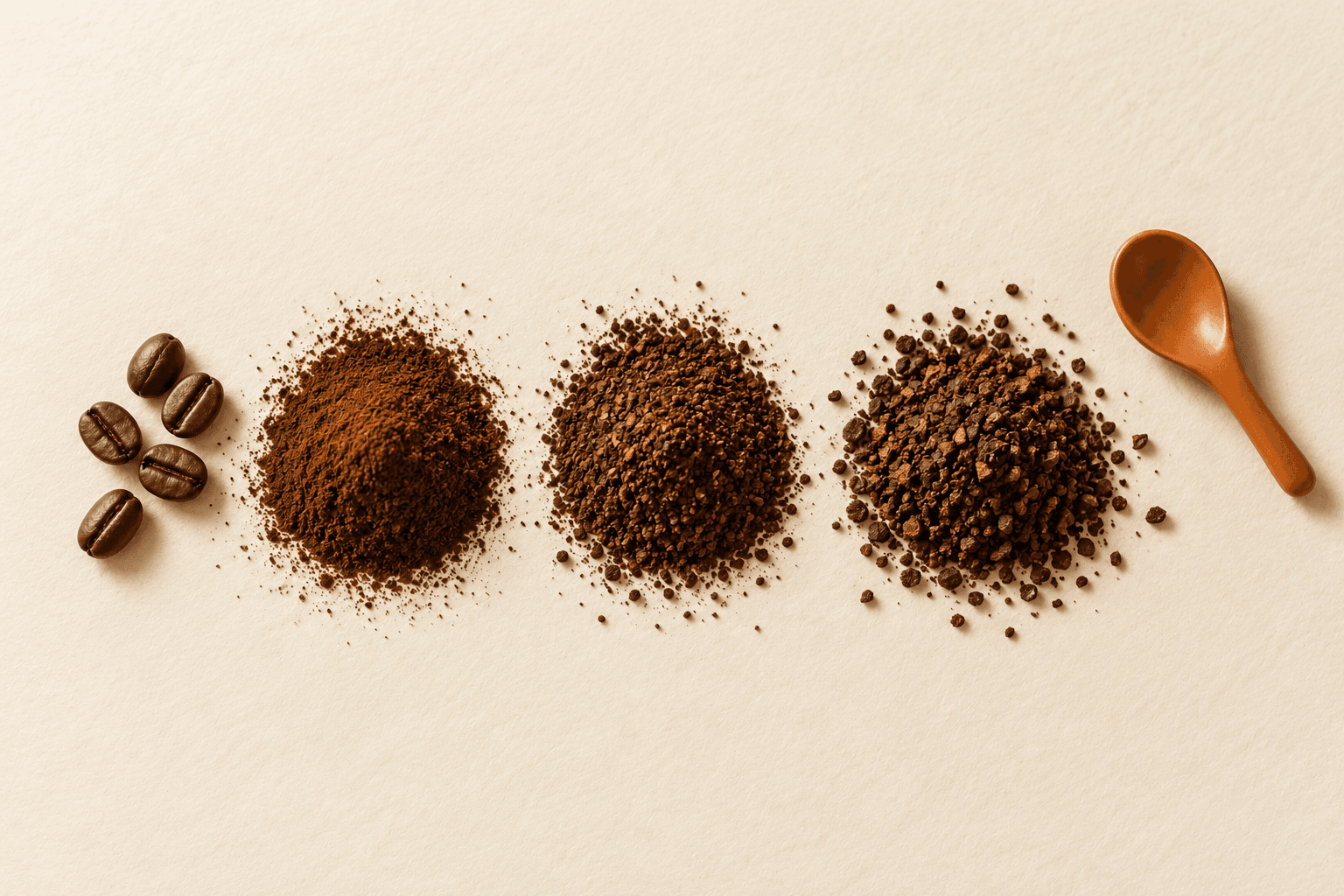
Start with the method
Each method has a typical range. Grinders label their ranges differently, so use these names as a starting point and let your first brew show where your grinder sits.
| Method | Typical grind | Feels like |
|---|---|---|
| Espresso | Fine | Fine table salt or a little finer |
| AeroPress | Medium-fine | Table salt |
| V60 and other pour-over | Medium-fine to medium | Coarse sand |
| Chemex | Medium-coarse | Rough sand |
| French press and cold brew | Coarse | Coarse sea salt |
Why one setting cannot fit every bean
Beans differ in roast level, density, age, and processing. A light roast may need a finer grind or more heat than a dark roast on the same grinder. The dial gives you a reference, not a universal answer.
Beans also change as they age, so a setting that worked last week may need a small nudge finer as the bag gets older.
Read the cup and the clock
A fast, sour, hollow brew often needs a finer grind. A slow, bitter, or drying brew often needs a coarser grind. Brew time is a clue that points you in a direction, but taste decides whether the cup needs changing at all.
Try it: taste check
What does the cup taste like?
Try a finer grind or a longer brew to extract more.
Hotter water also helps.
Use a controlled adjustment
Keep dose, water, temperature, and technique steady. Move the grinder a small amount, then look at both brew time and taste. If you make a large change, the cup may improve but you will not know how far the useful setting is from the old one.
For espresso, adjust the grind before changing dose and yield. For pour-over, adjust the grind before changing your pour pattern.
Common signs
Fines are the very small particles every grinder produces. Too many can make a cup taste drying even when the average grind looks right, and they can clog a filter or muddy an immersion brew. A fast pour-over can come from a coarse grind, a low pour, or a filter that drains quickly, so check the whole process before blaming the dial.
| What you notice | First check |
|---|---|
| Fast and sour | Grind finer and keep the recipe fixed |
| Slow and drying | Grind coarser and reduce agitation |
| Muddy and heavy | Check fines, the filter, and stirring |
| Thin but bitter | Check strength separately from extraction |
Record the direction
“Two clicks finer, less sour” is more useful than a setting number on its own. Keep the grinder name, the setting, and the taste together in Roastbook so the next bag starts from a setting you trust.