
Start with 20 grams and 320 grams
Use a 1:16 ratio as a calm starting point: 20 g of coffee and 320 g of water at about 94 °C, ground medium-fine. It makes one large mug or two small cups.
The ratio is the water weight divided by the coffee weight. Keep it fixed while you learn the brewer, and change the amounts together when you want more or less coffee.
Try it: brew ratio
See how strong your recipe really is
Ratio
1:16
Coffee share
5.9 %
Closest common recipe: V60 pour-over at 1:16.
Prepare the brewer
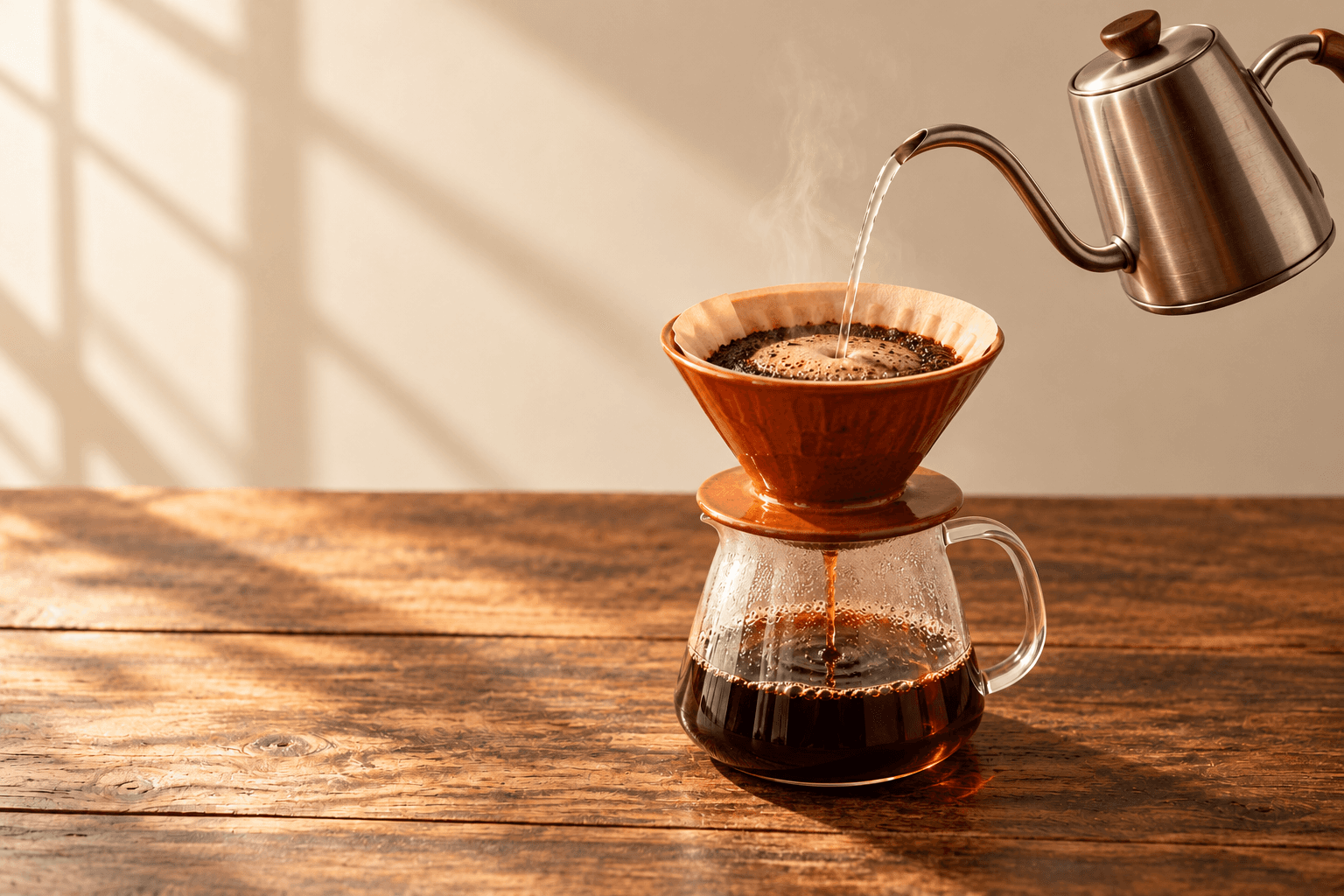
Rinse the paper with hot water to remove papery flavour and warm the brewer. Empty the rinse water before adding coffee. Place the brewer and server on the scale and zero it, so the scale shows only the water you pour.
Grind just before brewing and shake the bed level. A flat bed makes the first pour easier to repeat.
Bloom, then pour in stages
Start the timer and pour about twice the coffee weight in water, 40 g for this recipe, just enough to wet all the grounds. Wait 30 to 45 seconds while the fresh coffee releases gas. This step is called the bloom.
Then pour the rest in three equal stages: to about 135 g at 0:45, 225 g at 1:20, and 320 g at 1:55. Pour in slow circles, keep the bed level, and avoid pouring onto the paper walls. Use the planner to scale the schedule to your own dose.
Try it: pour schedule
Scale the pour schedule to your dose
Total water
320 g
- 0:00 Bloom: pour to 40 g and wait
- 0:45 Pour to 135 g
- 1:20 Pour to 225 g
- 1:55 Pour to 320 g
Aim for the bed to finish draining around 2:45 to 3:30. Larger doses drain more slowly, so allow a little longer between pours.
Use time as a clue
A brew that finishes draining around 2:45 to 3:30 is a reasonable first window. If it finishes quickly and tastes sour, grind finer. If it stalls and tastes dry, grind coarser.
If the bed drains much faster or slower than usual with the same grind, note it. The cause may be the filter, the water, or how vigorously you poured.
Adjust the recipe by taste
Sour or hollow coffee usually needs more extraction: grind finer, pour a little more actively, or use hotter water. Bitter or drying coffee usually needs less extraction: grind coarser or pour more gently.
Change one lever and repeat the brew. Save the result even when it is imperfect, because the failed cup explains the next setting.
| Taste | First change |
|---|---|
| Sour and thin | Grind finer |
| Bitter and dry | Grind coarser |
| Sweet but too strong | Use a longer ratio, such as 1:17 |
| Weak but bitter | Use more coffee for the same water, then grind a little coarser |
Save the recipe that worked
Once the cup tastes sweet and clear, save the dose, water, temperature, grind, and pour times with the coffee and grinder in Roastbook. The next bag can start from that recipe instead of from zero.